
In a discussion with youth and women trade union leaders of Tongi area at the orientation programme titled Advocacy for Green Development for RMG in Bangladesh, organized by the Bangladesh Institute of Labour Studies-BILS in collaboration with the Canadian Fund for Local Initiatives (CFLI), the speakers said that the government, owners, and workers must work together to improve the environment of the factory and residential area community and address the impact of climate change. Stating that trade unions must play a leading role in this regard, they said that youth and women trade union leaders can play a successful role in raising awareness among the workers and community living in labour-intensive areas.
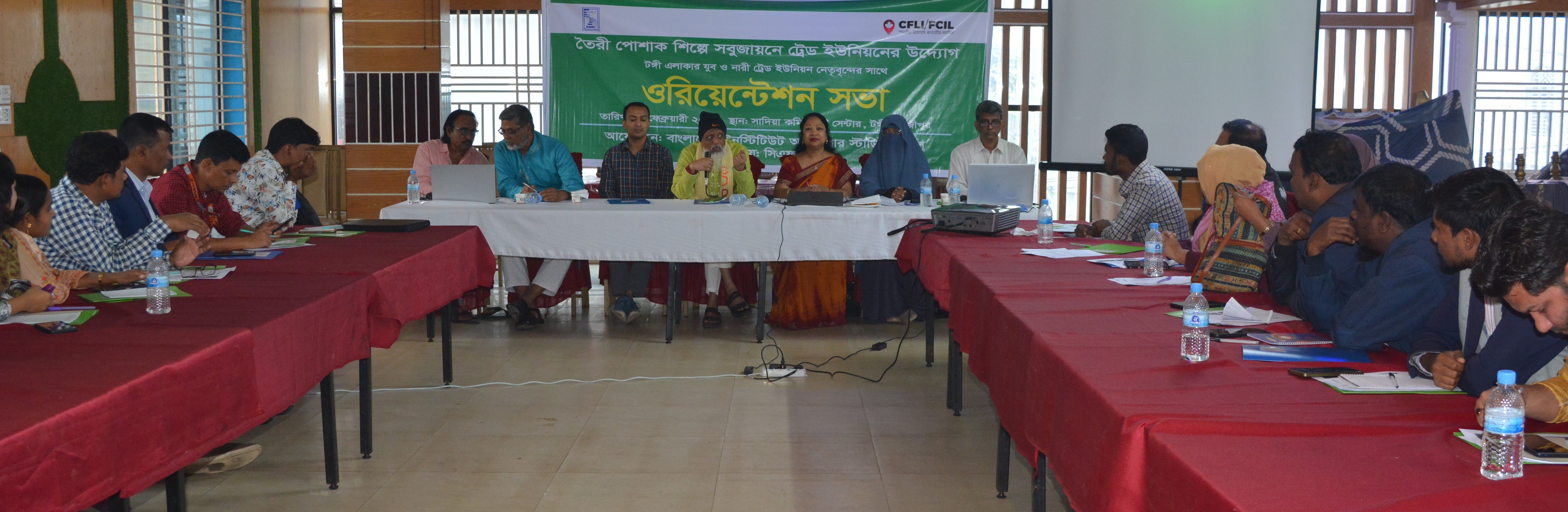
The event, organized on 11 February 2025 at a local community center in Tongi under the chairmanship of senior trade union leader and General Secretary of Bangladesh Mukto Sramik Federation Md. Mojibur Rahman Bhuiyan, was addressed by GSKOP Coordinator Naimul Ahsan Jewel, BILS Director Nazma Yesmin, Senior Trainer ABM Sazzad Hossain, Senior Manager (Ethical Trade) of Ecotex Ltd. Nahidun Nabi, Assistant Manager of Masco Industries Ltd. Kamrun Nahar, Cultural Activist Shekanul Islam Shahi, Project Coordinator Yousuf Al-Mamun, Program Officer Jhakia Begum Neelima, and others.

The speakers at the event said that it is possible to advance the work of protecting the environment through proper use of ETP, saving electricity through the construction of solar panels, recycling production materials and waste through proper waste management, utilizing liquid waste in the production of other products, etc., and at the same time reduce carbon emissions by reducing the use of fossil fuels. In addition, maternity leave for workers, provision of lunch, childcare centers in factories, etc. can help reduce worker fatigue and reduce family stress. They commented that young leaders can, through their initiatives, make factories that are not careful about waste management advocacy and lobby with them. In this case, they can highlight good examples of lead certifying factories. The speakers emphasized that environmental development work should be taken forward at the community level as well as the factory level. In this regard, they mentioned that young and women trade unionists need to work at the front line.
It is worth noting that the aim of this project is to increase the capacity of young and women trade unionists to maintain improved environmental and social standards in the ready-made garment sector. This program will try to solve problems by encouraging garment workers and local communities to demand environmentally friendly production processes through the promotion of environmental development practices. As a result, it will be possible to increase awareness about environmental and climate change laws, improve emergency preparedness, and increase the skills and capacity of workers and trade unions. This project will also help expand the network of women and youth trade unionists to popularize the demand for environmental development practices. After the successful completion of the program, it is expected that the involvement of trade unions in environmental development practices for workers and the public will be further strengthened.