
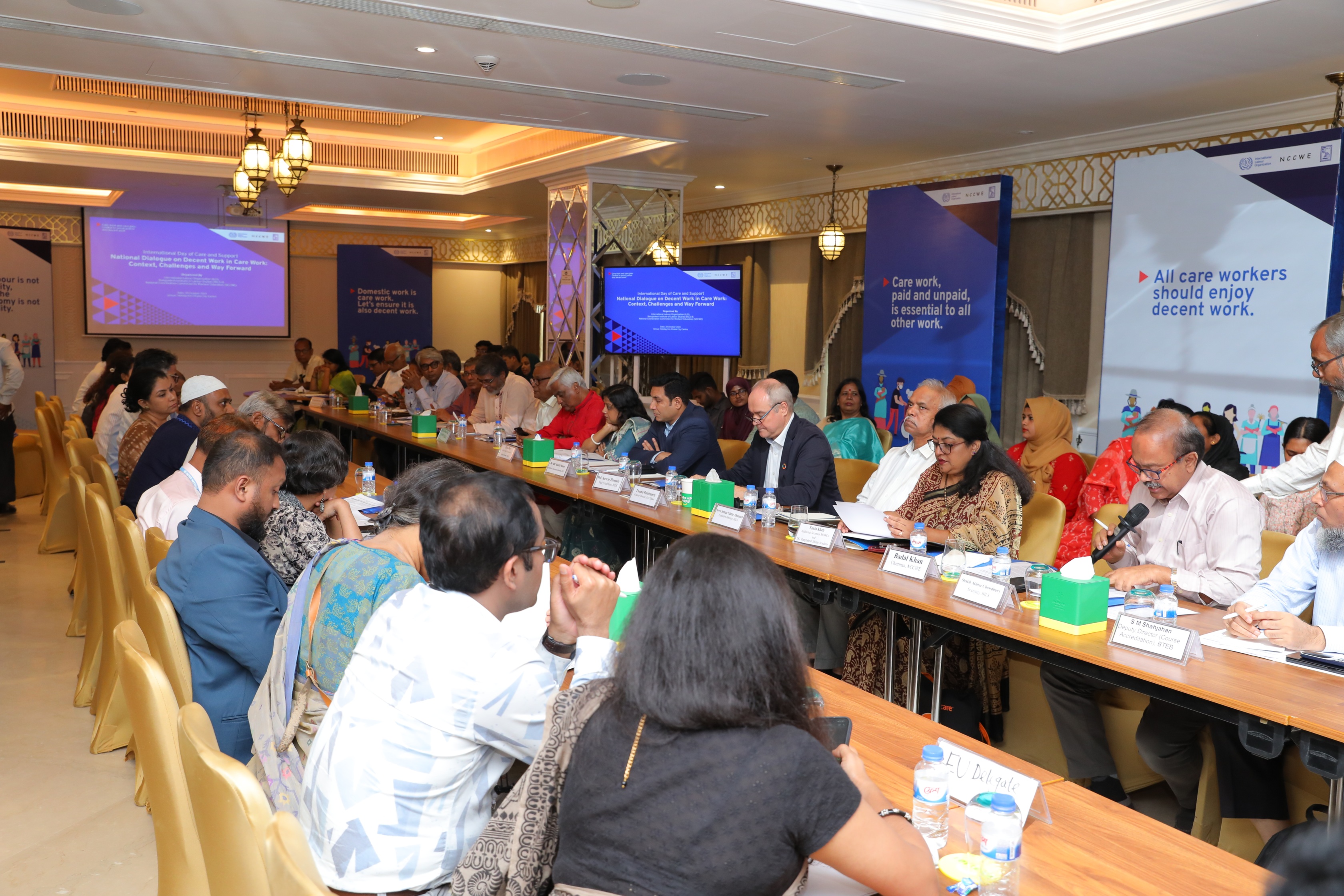
Bangladesh Institute of Labour Studies – BILS, Internation Labour Organization – ILO and The National Coordination Committee for Workers’ Education (NCCWE) hosted a National Dialogue on Decent Work in Care Work to observe the International Day of Care and Support on 29 October 2024. The objective of the dialogue was to address the context, challenges, and future directions for enhancing decent work conditions in the care sector. The dialogue was attended by representatives from the government, training institutions, trade union leaders, youth representatives from trade unions, employers’ representatives, care provider agencies, care workers, researchers, development partners, CSOs, and UN agencies.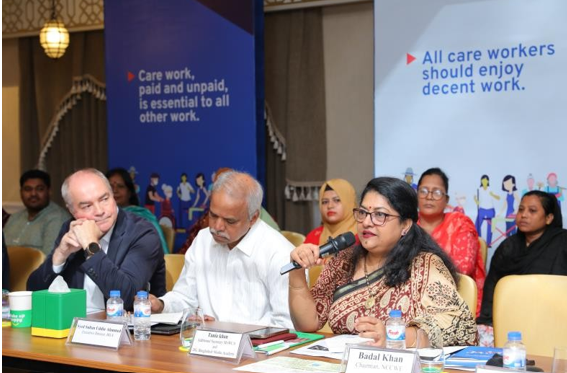
The dialogue was moderated by Shakil Akhter Chowdhury, Secretary of BILS, and began with welcoming remarks from Syed Sultan Uddin Ahmmed, Executive Director of BILS. Anne Drong, National Programme Coordinator at ILO, provided context for the session which was followed by Nazma Yesmin, Director of BILS, who outlined ongoing initiatives in the care economy led by trade unions and worker organizations. Mostafiz Ahmed, Associate Professor at Jagannath University, presented on the challenges and decent work deficits faced by care workers. The dialogue included experience-sharing from five care workers, allowing them to voice their perspectives. An open discussion followed, with active engagement from all the discussants, and the event concluded with closing remarks by Syed Sultan Uddin Ahmmed. The total participants of the programme were 95 (Female-32, Male-63).
The dialogue began with the welcoming remarks of Syed Sultan Uddin Ahmmed, who cordially welcomed all the participants and expressed his enthusiasm for making progressive advancements in the care sector. He highlighted a recent incident of a domestic worker violence in Bashundhara, where a teen girl was severely abused by her employer. Sultan Uddin Ahmmed pointed out that, to date, caregivers have not received legal or social recognition, which is why there is no established code of conduct for either employers or workers. He emphasized the need for a social framework and networking within the care work sector.
Nazma Yesmin, Director, BILS, began by saying that we are observing the International Day of Care and Support in Bangladesh for the first time. She also mentioned how covid-19 experience has taught us the value of our caregivers. She also mentioned as various research has showed that by 2030 we need plenty of child care and elderly care, and it is crucial that we begin working on this matter immediately.
Anne Drong, National Project Coordinator, ILO started by saying that we need to ensure the care of children of working mothers in the workplace, with a focus on income security, service quality, and the representation of care workers.
Mostafiz Ahmed shared the research finding through a presentation where he highlighted several areas of concern using key decent work indicators such as Employment opportunities, adequate earnings and productive work, Decent working hour, Combining Work family and personal life, Work that should be abolished, stability and security of work, equal opportunity and treatment in employment, safe work environment, social security, social dialogue, employers’ and workers representation.
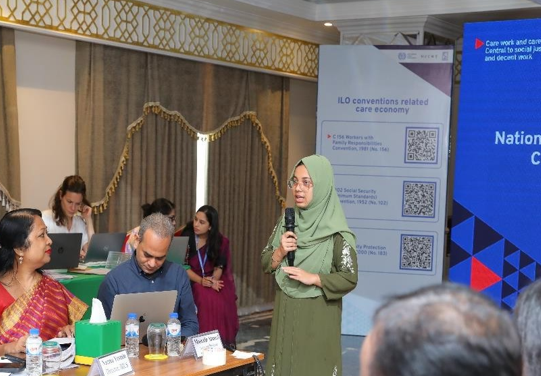 He pointed out that 91.5% of care workers are hired directly by employers, with limited involvement from labour-supplying firms or referrals. Social connections remain the primary way workers to find jobs, with some use of online platforms. He also highlighted that while permanent positions are more common for nurses, the majority of care workers, such as those in childcare and domestic work, hold temporary or contractual positions.
In discussing job security, he emphasized the vulnerability of care workers to abrupt dismissal, with 39.6% of workers, particularly in domestic (45%) and healthcare roles (52%), experiencing job loss without notice. He also noted that working hours vary, with eldercare workers, in particular, enduring lengthy shifts of 11-12 hours, often without overtime provisions. When overtime is offered, compensation practices are inconsistent, with many workers not receiving the standard double rate for additional hours. He also highlighted that the majority of care workers are not covered by government-set minimum wage protections, except for certain childcare and nursing roles. Awareness of wage regulations is low among workers, with 40% unaware of minimum wage laws and 25% misinformed about their application.
Kohinur Akhter Kobita, a childcare provider from Ayat Care, shared that she has been working as a caregiver for the past 10 months. Although she did not receive formal training, her experience as a mother helped her secure the job through Ayat Care. She mentioned that she does not have an ID card or an appointment letter for her position. Kohinur expressed that, in our society, home service jobs like hers are not seen as respected professions.
Md. Mainuddin, an elderly Caregiver, shared his experience. He has completed Level 2 and 3 training with Ayat Care and works as a live-in caregiver, meaning he is effectively on duty 24 hours a day. He mentioned that, through Ayat Care, he receives his salary reliably. However, his pay is deducted if he takes any leave.
In the open discussion, Tanjum Ara Polly from Bharasha Institute, shared that their organization offers comprehensive caregiver training courses. Upon successful completion of the training, Bharasha offers employment opportunities to those who is interested to work as caregivers.
Rabita Islam, Karmojibi Nari, mentioned that the care sector is relatively new in Bangladesh, which is why there is a lack of awareness.
Mominur Rahman, Research Associate, shared his experience speaking with caregivers and highlighted the many unspoken hardships they endure in our country. He emphasized that caregivers often receive unfair wages for their demanding work, with many having to stay overnight in clients’ homes or hospitals.
S.H.M. Magfurul Hasan Abbasi, Senior Assistant Secretary of the Ministry of Labour and Employment (MoLE), began by thanking the organizers for arranging such a valuable event. He noted that it would have been beneficial to hear perspectives from both caregivers and employers, as only the caregivers’ side was represented.
Laila Karim from Ayat Education focused on the way forward for developing the care sector. She emphasized that professionalism has yet to be fully established, which is crucial to ensuring social justice and decent work in this field.
Md. Saidul Islam, Additional Secretary General, Bangladesh Employer Federation (BEF), began by noting that, in some way, we are all employers. He observed that while the care sector has developed recently, it remains very scattered.
Tahera Jaben, Social Development Officer at the British High Commission, highlighted three key issues. First, she emphasized the need to standardize the quality of care. Secondly, she discussed the importance of coordination among ministries. Thirdly, she stressed the need for a mechanism to ensure accountability in the care sector.
Badal Khan, Chairman, NCCWE stated that while care work is an old concept, it now requires a fresh approach. To ensure social justice and decent work, he believes that all aspects—wages, accommodation, and living standards of a care worker must be decent.
S M Shahjahan, Deputy Director of BTEB, mentioned that BTEB has already developed a curriculum for caregiving. He emphasized that to establish a formal sector, trade union representatives can play a crucial role as a pressure group to raise awareness and advocate for the development of relevant legislation.
Siddiqur Rahman from UN Women briefly noted that much has already been discussed about the sector, but he wanted to emphasize the formalization of the care economy.
 Razzequzzaman Ratan, president, SLF highlighted that, despite being an essential part of society, caregivers remain unrecognized. He pointed out that in Bangladesh, there are approximately 15 million children under the age of five and more than 10 million elderly people are over 60, meaning around 25 million people, at least, currently need care. This demand is rapidly growing due to social changes such as increased female employment and a rise in nuclear families.
Tania Khan, Additional Secretary of MoCWA & DG, Bangladesh Shishu Academy shared her remarks on this issue. She stated that the distinction between domestic workers and caregivers needed to be more clarified in the research, as the contexts of these two sectors differ significantly. Nonetheless, improving both sectors is equally important. She emphasized the need to care for caregivers and ensure their social security. She also pointed out that, although many of us have caregivers in our homes, we often overlook their needs, such as a proper washroom or a separate bed for rest. She believes that if care recipients show care, respect, and kindness toward caregivers, they will, in turn, be more dedicated to their responsibilities.
Shilu Roy, Director Skills Coordination & Deputy Secretary, NSDA noted that it would have been helpful if the research had included insights on the situation of skilled caregivers—whether they have access to proper opportunities, fair salaries, or face discrimination.
Toumo Poutiainen, Country Director, ILO discussed the necessity to address this challenge for Bangladesh along with the challenges and what can be the role for government, trade union and other stakeholders. He reflected on the discussions, stating that it is crucial for Bangladesh to address these issues and develop a shared vision for a better ecosystem in the care sector. He emphasized the need to build professionalism in the sector, aligned with global standards, noting how the functioning of a modern society heavily depends on the care sector and care economy.
Razzak Vila, House-8/A/Ka (4th Floor), Road-13(New), Dhanmondi, Dhaka.