
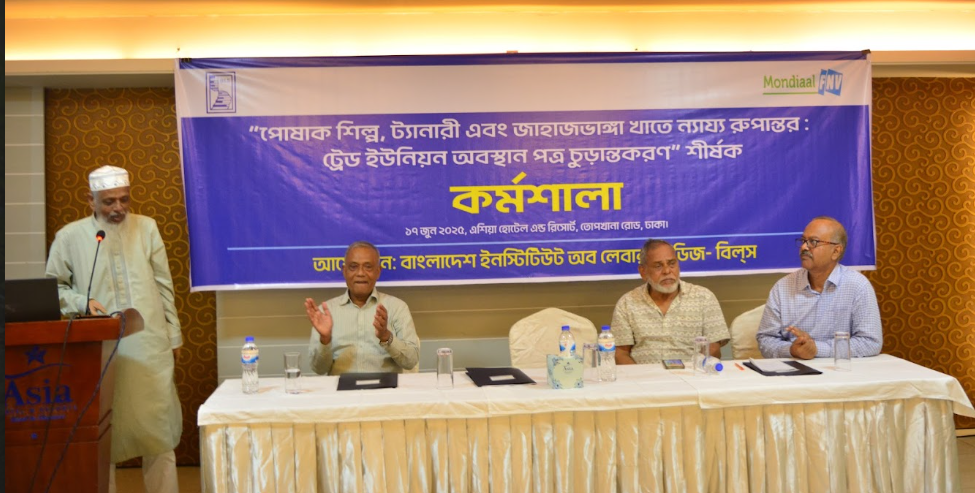
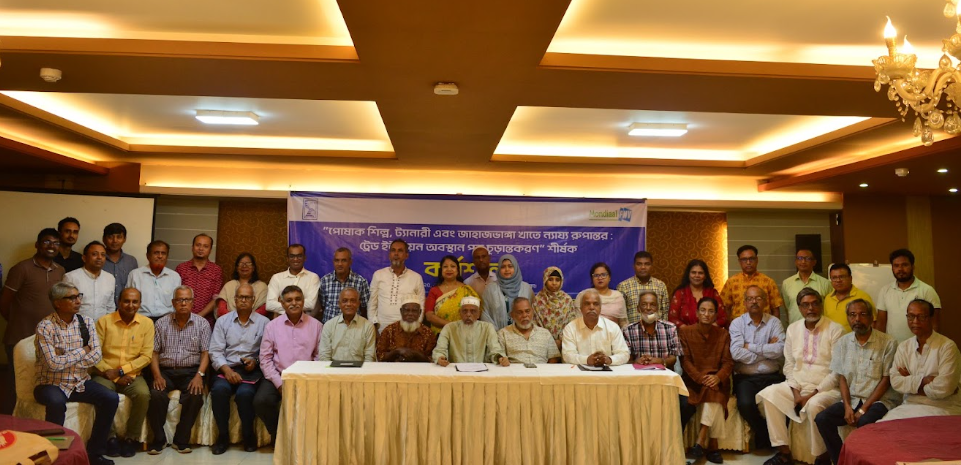
 A workshop titled “Fair Transition in Garment Industry, Tannery and Shipbreaking Sectors: Finalizing Trade Union Position Paper” was held at a local hotel in the capital on June 17, 2025, at the initiative of Bangladesh Institute of Labour Studies-BILS and in collaboration with Mondiaal FNV. A total of 40 trade union leaders, including representatives of Sramik Karmachar Oikya Parishad (SCOP), NCCWE, IBC, Ship Breaking Workers Trade Union Forum and Tannery Union, were present at the workshop.
Chaired by BILS Vice Chairman Md. Mojibur Rahman Bhuiyan and moderated by BILS Executive Council Secretary Abul Kalam Azad and SKOP Joint Coordinator Anwar Hossain delivered the welcome address at the workshop. Among others, IBC’s Amirul Haque Amin, NCCWE Chairman Badal Khan, BILS Advisory Council Member Naimul Ahsan Jewel, Executive Director Syed Sultan Uddin Ahmmed, Tannery Workers Union General Secretary Abdul Malek, Shipbreaking Forum Representative Shahidullah Badal and BILS Director Nazma Yesmin also addressed. Maulana Bhashani Science and Technology University Assistant Professor Aurongajeb Akond presented the position of the trade union based on the recommendations received in the previous workshop. BILS Executive Council Secretary Shakil Akhter Chowdhury presented it with the aim of compiling the leaders’ recommendations and finalizing the position paper.
The leaders said that the garment industry, tannery and shipbreaking sectors are among the important sectors for Bangladesh in earning foreign exchange. But structurally, these industries are not able to ensure decent working conditions for workers. On the other hand, environmental disasters have further exacerbated this plight of workers. 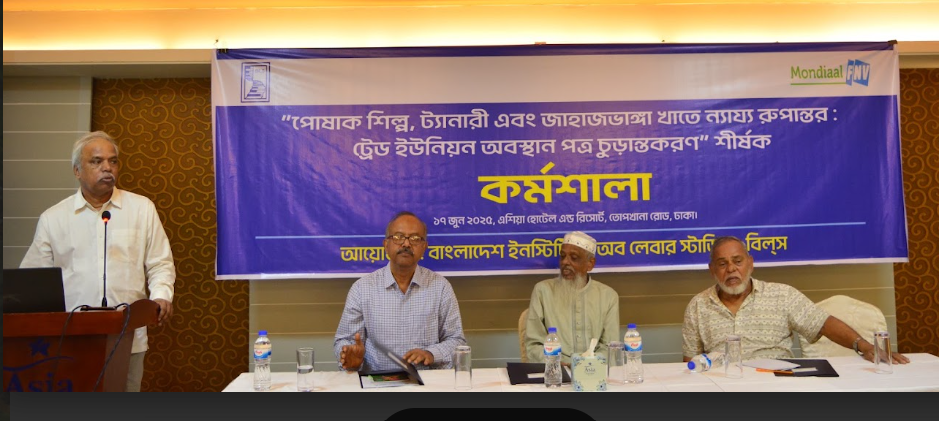 Therefore, in order to make these industrial sectors sustainable, workers’ rights and protection are important issues in the green and just transformation process like in other countries of the world. Without the initiative and support of trade union federations, it is impossible to fully implement the green and just transformation process in the above-mentioned industrial sectors. They said, if the green and just transformation process is implemented through the initiative of trade unions, on the one hand we will move towards a low-carbon and climate-resilient economy, on the other hand the rights and protection of workers will also be ensured. As a result, we believe that Bangladesh will be able to move towards establishing itself as a country with social equality, economic stability and environmental sustainability. It is worth noting that BILS, with the support of the Netherlands-based organization Mondiaal FNV, has conducted a research program to determine the ongoing green and just transformation process in the ready-made garment industry, tannery and shipbreaking sectors of Bangladesh and what needs to be done to ensure the partic
  ipation, fair share and protection of rights of workers in this process. Based on the results of the research, trade union leaders provided their views on how to make the ongoing transformation process in these sectors fair for workers at a workshop held on May 22, 2025. This workshop was organized with the aim of finalizing the trade union position to make the green transformation process more fair for workers based on the recommendations of the leaders in the previous workshop.
Therefore, in order to make these industrial sectors sustainable, workers’ rights and protection are important issues in the green and just transformation process like in other countries of the world. Without the initiative and support of trade union federations, it is impossible to fully implement the green and just transformation process in the above-mentioned industrial sectors. They said, if the green and just transformation process is implemented through the initiative of trade unions, on the one hand we will move towards a low-carbon and climate-resilient economy, on the other hand the rights and protection of workers will also be ensured. As a result, we believe that Bangladesh will be able to move towards establishing itself as a country with social equality, economic stability and environmental sustainability. It is worth noting that BILS, with the support of the Netherlands-based organization Mondiaal FNV, has conducted a research program to determine the ongoing green and just transformation process in the ready-made garment industry, tannery and shipbreaking sectors of Bangladesh and what needs to be done to ensure the partic ipation, fair share and protection of rights of workers in this process. Based on the results of the research, trade union leaders provided their views on how to make the ongoing transformation process in these sectors fair for workers at a workshop held on May 22, 2025. This workshop was organized with the aim of finalizing the trade union position to make the green transformation process more fair for workers based on the recommendations of the leaders in the previous workshop.